
Asthma Care in Troy, MI

Duraid Ahad-Daman, MD
Family Medicine located in Troy, MI
Wheezing, a persistent cough, or shortness of breath deserves a closer look. Dr. Duraid Ahad-Daman provides asthma evaluation and ongoing care at Ahad MD PC in Troy, Michigan.
In-office pulmonary function testing is available at our clinic.
Asthma care focused on better breathing
Pulmonary function testing in our Troy office
Ahad MD PC offers in-office pulmonary function testing. Spirometry measures how much air you breathe out and how quickly. Your clinician considers the results along with your symptoms and medical history. A normal result on one day does not always rule out asthma; repeat testing may be needed.
Bring your inhalers and medication list. Ask our team how to prepare for testing. Do not stop prescribed medicines unless instructed.
What is asthma? What symptoms should I notice?
Asthma is a long-term condition in which the breathing tubes in your lungs become swollen and narrow. The muscles around them can tighten, making breathing harder. Treatment can help you stay active and prevent serious attacks.
Common symptoms include:
- Wheezing: a whistling sound when you breathe.
- Coughing: often at night, early in the morning or with exercise.
- Shortness of breath: feeling that you cannot get enough air.
- Chest tightness: pressure or a squeezing feeling in your chest.
Symptoms often come and go. Colds, exercise, cold air, smoke or allergens may bring them on. Other conditions can cause similar symptoms, so a medical assessment matters.
What does controlled asthma look like?
The goal is comfortable breathing, uninterrupted sleep and normal activity. For adults and teens, review the past four weeks:
- Did you have daytime symptoms on more than two days a week?
- Did asthma wake you at night?
- Did asthma limit your activities?
- If you use albuterol alone or another short-acting-only rescue inhaler, did you need it for symptoms on more than two days a week? Do not count use before exercise. Steroid-containing relievers are assessed differently; ask your clinician how to assess yours.
No “yes” answers: symptoms are well controlled. One or two: partly controlled. Three or four: uncontrolled. Any “yes,” or increasing reliever use, is a reason to review your plan. Children need age-appropriate assessment.
Feeling well does not eliminate the risk of a future attack. Your clinician also checks previous attacks, breathing-test results and medication use. Even people with infrequent symptoms can have a severe attack.
What are the main asthma medicines?
- Inhaled corticosteroids (ICS): reduce swelling inside the airways. They are the foundation of treatment that prevents attacks. They may be in a daily inhaler or a prescribed combination reliever.
- Combination controller inhalers (ICS/LABA): combine an inhaled steroid with a long-acting medicine that keeps airways open. A LABA should not be used alone for asthma. Not every combination inhaler works as rescue treatment.
- Quick-relief medicines: open narrowed airways when symptoms occur. Some also contain an inhaled steroid. See the rescue section below.
- Other add-on treatments: a long-acting airway-opening inhaler called a LAMA, or tablets called leukotriene modifiers, may help selected patients.
- Biologic medicines: injections targeting particular causes of inflammation, usually for selected patients with severe asthma under specialist care.
- Steroid tablets or liquids: sometimes needed for a significant flare-up, not routine daily treatment. They are not a substitute for a quick-relief inhaler and should be used only as prescribed.
Montelukast, a leukotriene tablet, has an FDA boxed warning about serious mood and behavior changes. Discuss its benefits and risks; stop it and contact your clinician promptly if these changes occur.
What is rescue treatment?
A rescue or reliever inhaler treats symptoms as they happen. Know which inhaler is yours and follow your written instructions.
- Albuterol opens the airways quickly but does not treat the underlying swelling.
- Albuterol plus budesonide combines quick relief with an inhaled steroid. This combination is FDA-approved for adults age 18 and older, not children.
- Certain inhaled-steroid/formoterol inhalers can be prescribed for relief, sometimes also as the daily controller. This approach is guideline-supported, but rescue use is outside current U.S. FDA labeling. Use it only with a specific clinician-written plan. Do not substitute another combination inhaler.
Needing relief more often, or finding it does not last, means your asthma needs prompt review. Do not keep increasing treatment beyond your action plan.
U.S. asthma inhaler guide — reviewed October 24, 2026
This chart covers verified U.S. handheld inhaler families, not every manufacturer, strength or package. Availability can change. Medicines and age limits differ; follow your own prescribed plan.
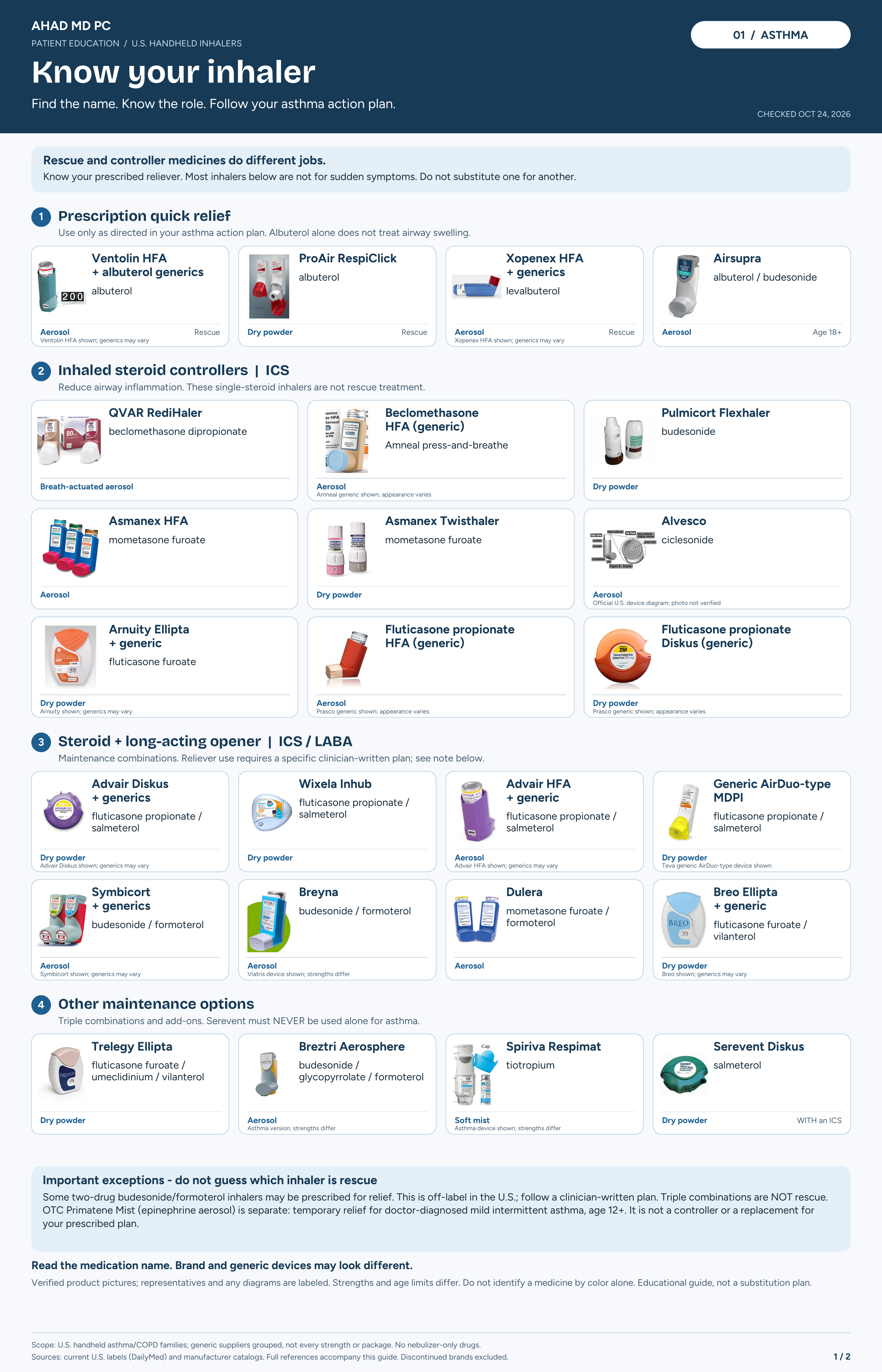
Read the inhaler list and safety notes
Rescue and controller medicines do different jobs. Know your prescribed reliever. Most inhalers below are not for sudden symptoms. Do not substitute one for another.
Prescription quick relief
Use only as directed in your asthma action plan. Albuterol alone does not treat airway swelling.
- Albuterol HFA (Ventolin HFA and generics) — albuterol; Aerosol; Prescribed quick relief (Rescue).
- ProAir RespiClick — albuterol; Dry powder; Prescribed quick relief (Rescue).
- Xopenex HFA and generics — levalbuterol; Aerosol; Prescribed quick relief (Rescue).
- Airsupra — albuterol / budesonide; Aerosol; Prescribed quick relief; asthma age 18+ (Age 18+).
Inhaled steroid controllers | ICS
Reduce airway inflammation. These single-steroid inhalers are not rescue treatment.
- QVAR RediHaler — beclomethasone dipropionate; Breath-actuated aerosol; Maintenance; not rescue.
- Beclomethasone dipropionate HFA (Amneal generic) — beclomethasone dipropionate; Aerosol; Maintenance; not rescue.
- Pulmicort Flexhaler — budesonide; Dry powder; Maintenance; not rescue.
- Asmanex HFA — mometasone furoate; Aerosol; Maintenance; not rescue.
- Asmanex Twisthaler — mometasone furoate; Dry powder; Maintenance; not rescue.
- Alvesco — ciclesonide; Aerosol; Maintenance; not rescue.
- Arnuity Ellipta and generic — fluticasone furoate; Dry powder; Maintenance; not rescue.
- Fluticasone propionate HFA (generic) — fluticasone propionate; Aerosol; Maintenance; not rescue.
- Fluticasone propionate Diskus (generic) — fluticasone propionate; Dry powder; Maintenance; not rescue.
Steroid + long-acting opener | ICS / LABA
Maintenance combinations. Reliever use requires a specific clinician-written plan; see note below.
- Advair Diskus and generic equivalents — fluticasone propionate / salmeterol; Dry powder; Maintenance; not rescue.
- Wixela Inhub — fluticasone propionate / salmeterol; Dry powder; Maintenance; not rescue.
- Advair HFA and generic — fluticasone propionate / salmeterol; Aerosol; Maintenance; not rescue.
- Fluticasone propionate / salmeterol MDPI (generic AirDuo RespiClick) — fluticasone propionate / salmeterol; Dry powder; Maintenance; not rescue.
- Symbicort and generics — budesonide / formoterol; Aerosol; Maintenance; not rescue.
- Breyna — budesonide / formoterol; Aerosol; Maintenance; not rescue.
- Dulera — mometasone furoate / formoterol; Aerosol; Maintenance; not rescue.
- Breo Ellipta and generic — fluticasone furoate / vilanterol; Dry powder; Maintenance; not rescue.
Other maintenance options
Triple combinations and add-ons. Serevent must NEVER be used alone for asthma.
- Trelegy Ellipta — fluticasone furoate / umeclidinium / vilanterol; Dry powder; Maintenance; not rescue.
- Breztri Aerosphere — budesonide / glycopyrrolate / formoterol; Aerosol; Maintenance; not rescue.
- Spiriva Respimat — tiotropium; Soft mist; Maintenance; not rescue.
- Serevent Diskus — salmeterol; Dry powder; Maintenance; not rescue (WITH an ICS).
Important exceptions - do not guess which inhaler is rescue
Some two-drug budesonide/formoterol inhalers may be prescribed for relief. This is off-label in the U.S.; follow a clinician-written plan. Triple combinations are NOT rescue. OTC Primatene Mist (epinephrine aerosol) is separate: temporary relief for doctor-diagnosed mild intermittent asthma, age 12+. It is not a controller or a replacement for your prescribed plan.
Product image sources
Product images and device diagrams are credited to the linked sources. Brand names and images belong to their respective owners. Appearance varies by manufacturer and strength; no endorsement is implied.
- Albuterol HFA (Ventolin HFA and generics) — GSK
- ProAir RespiClick — Teva
- Xopenex HFA and generics — Lupin
- Airsupra — AstraZeneca
- QVAR RediHaler — Teva
- Beclomethasone dipropionate HFA (Amneal generic) — Amneal
- Pulmicort Flexhaler — Fairview Physician Associates Network
- Asmanex HFA — Organon
- Asmanex Twisthaler — Organon
- Alvesco — DailyMed
- Arnuity Ellipta and generic — GSK
- Fluticasone propionate HFA (generic) — Prasco
- Fluticasone propionate Diskus (generic) — Prasco
- Advair Diskus and generic equivalents — GSK
- Wixela Inhub — Viatris
- Advair HFA and generic — GSK
- Fluticasone propionate / salmeterol MDPI (generic AirDuo RespiClick) — Teva
- Symbicort and generics — AstraZeneca
- Breyna — Viatris
- Dulera — Organon
- Breo Ellipta and generic — GSK
- Trelegy Ellipta — GSK
- Breztri Aerosphere — AstraZeneca
- Spiriva Respimat — DailyMed
- Serevent Diskus — Fairview Physician Associates Network
What do the latest guidelines say?
As of October 24, 2026: GINA’s 2026 guidance continues to favor treatment containing an inhaled steroid rather than albuterol alone for adults and teens. This protects against attacks as well as treating symptoms. The 2026 update adds anti-inflammatory reliever options, including new options for children ages 6–11. Children need age-specific prescribing; younger children follow a separate approach.
The latest U.S. NHLBI focused guideline update remains 2020. Recommendations and FDA-approved uses are not identical, so your plan should fit your age, medical history and available inhalers.
Everyday steps that make treatment work
Bring your inhalers to visits so we can check your technique. Ask whether a spacer is right for your device. Get a written asthma action plan explaining regular treatment, what to do when symptoms worsen and when to seek help.
Avoid smoke and vaping, and reduce exposure to triggers that affect you. Discuss nasal allergies if they are a problem. Stay active with an appropriate plan. Keep follow-up visits and arrange a review after a flare-up. Tell us if cost, side effects or a confusing routine make medicines hard to use.
Call 911 for severe breathing difficulty, trouble speaking, blue or gray lips, confusion or unusual drowsiness, or when your prescribed reliever is not helping. Follow your emergency action plan while waiting for help. Do not wait for an office appointment.
Schedule an asthma evaluation
Ask about asthma follow-up and in-office pulmonary function testing at Ahad MD PC.
Trusted asthma information and guidelines
Explore these resources for patient education and professional guidance:
- CDC: About asthma — Patient information about symptoms, triggers, and asthma care.
- American College of Chest Physicians (CHEST): Asthma resources — Asthma education and clinical resources from a professional chest medicine society.
- GINA: 2026 asthma management and prevention guidelines and 2026 Summary Guide — Evidence-based guidance for health professionals.
- AAAAI: Asthma symptoms, diagnosis, and treatment
- NHLBI: Understanding asthma, treatment and action plans, and 2020 focused guideline updates.
- FDA: Combination rescue treatment for adults and montelukast safety warning.
- Current prescribing information: albuterol/budesonide and budesonide/formoterol.
- MedlinePlus: Signs of an asthma attack.
Links open in a new tab. Information current October 24, 2026. This education does not replace your individual asthma action plan.